
Savaysa vs Eliquis: Which Blood Thinner is Right for You?
speciality medications
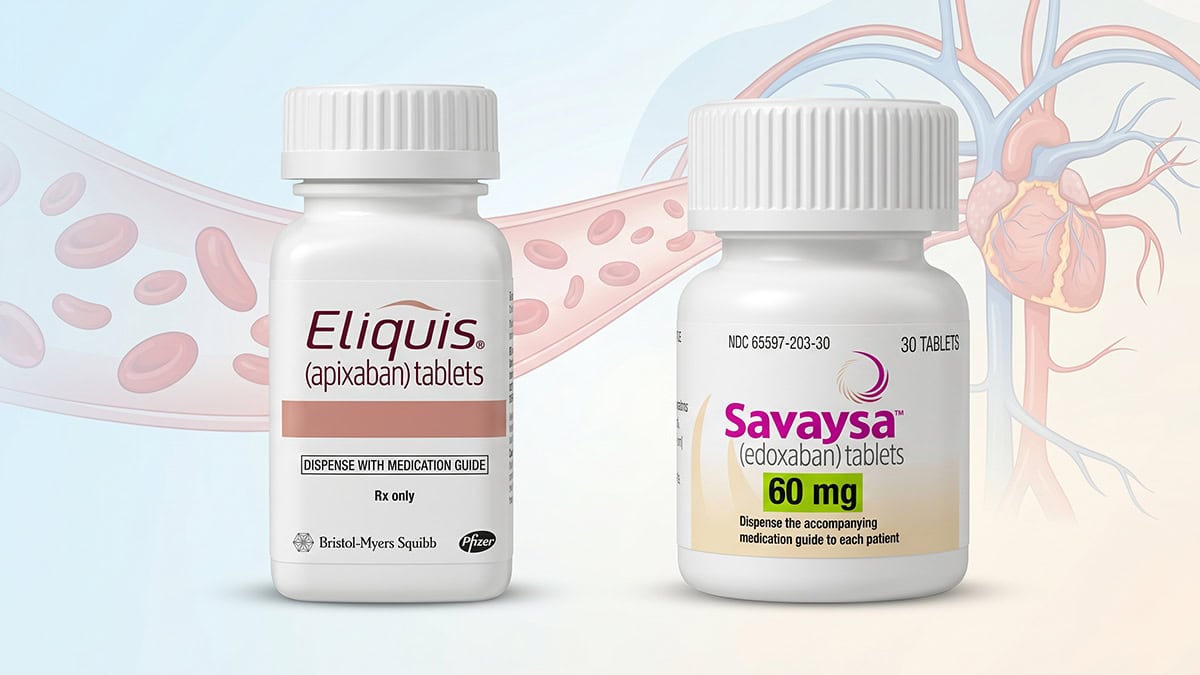
If you need a blood thinner, if your doctor has mentioned that you may have a clotting condition, or if you have a loved one in either of these categories, there’s no way you haven’t come across two names:
Savaysa and Eliquis.
There’s a good reason for that.
Both Savaysa and Eliquis belong to a newer generation of anticoagulants that have completely transformed the treatment and prevention of blood clots.
More traditional medications for treating blood clotting conditions worked, but they did so with unpredictable side effects and the need for lots (lots!) of routine monitoring.
Routine monitoring and some side effects are part and parcel with powerful prescription medications, but when a new set of anti-clotting meds that came with more predictable side effects and less required routine monitoring arrived on-scene, patients and their doctors were, reasonably, quite excited.
So – of these two medications – Savaysa or Eliquis – which is best for you?
(Are either in your future?)
The best way to figure out the answer to this question is, of course, to speak with your doctor.
But we can get you some helpful information to assist you in making this decision. While these medications share many similarities, they are not identical. Understanding how they work, what they're used for, and how they differ can help patients have more informed conversations with their healthcare providers.
What Is Savaysa?
Savaysa is the brand name for edoxaban, a prescription anticoagulant medication.
Although people commonly refer to anticoagulants as "blood thinners," they do not actually thin the blood.
Instead, they reduce the blood's ability to form potentially harmful clots.
This is important because blood clots can sometimes develop inside blood vessels and travel to critical organs, potentially causing serious medical complications.
Savaysa – an anticoagulant – is, to be even more specific, something called a “direct oral anticoagulant.” (Sometimes, you’ll see this abbreviated as a DOAC.)
DOACs are designed to interfere with specific parts of the body's clotting process, helping reduce the likelihood of dangerous clot formation.
Savaysa Indications: What Is Savaysa Used For?
Savaysa is prescribed for certain conditions involving abnormal blood clot formation or an increased risk of clot-related complications.
Let’s break it down a bit further.
Doctors may prescribe Savaysa for …
Stroke Risk Reduction in Certain Patients With Atrial Fibrillation
Atrial fibrillation (or AFib) is a heart rhythm disorder that can increase the risk of blood clot formation.
When clots form inside the heart, they may travel through the bloodstream and potentially cause a stroke.
For certain patients with non-valvular atrial fibrillation, Savaysa may be prescribed to help reduce this risk.
Treatment of Deep Vein Thrombosis (or DVT)
Deep vein thrombosis occurs when a blood clot forms in a deep vein, most commonly in the legs.
Symptoms of DVT may include:
- Swelling
- Pain
- Warmth
- Redness
DVT is a serious condition because part of the clot can sometimes break away and travel to the lungs.
Treatment of Pulmonary Embolism (PE)
A pulmonary embolism occurs when a blood clot blocks blood flow in the lungs.
This can be a medical emergency and may cause symptoms such as:
- Shortness of breath
- Chest pain
- Rapid heart rate
- Dizziness
Blood thinners, like Savaysa, are often used as part of a more comprehensive PE treatment strategy, and are designed to prevent additional clot formation (and thereby reduce overall risk of adverse effects).
Savaysa Mechanism of Action: How Does Savaysa Work?
As we noted above, Savaysa is a DOAC (a direct oral anticoagulant).
That’s not all it is.
Savaysa is also classified as a Factor Xa inhibitor.
Factor Xa is one of the key proteins involved in the body's clotting cascade, or the series of chemical reactions that allows blood clots to form.
By blocking Factor Xa, Savaysa reduces the body's ability to generate something called “thrombin.” (Thrombin is also an important substance involved in clot formation.)
Why Factor Xa Inhibitors Became So Popular
Savaysa, a Factor Xa inhibitor, helps stop clotting very well, with fewer side effects than more traditional anticoagulants.
Eliquis – a medication that Savaysa often gets compared to – is also a Factor Xa inhibitor. We’ll get more into their differences in a moment, but that's what they have in common.
Why do people like Factor Xa inhibitors so much for treating clotting disorders?
Before medications like Savaysa and Eliquis became widely available, many patients relied on older anticoagulants such as warfarin.
While warfarin remains an important medication in certain situations, it often requires:
- Regular blood testing
- Ongoing dose adjustments
- Careful monitoring of dietary vitamin K intake
- More frequent management of drug interactions
Factor Xa inhibitors such as Savaysa and Eliquis were developed to provide a more predictable anticoagulant effect.
For many patients, this means:
- Fixed dosing schedules
- Fewer routine monitoring requirements
- Less dietary disruption
- Simplified long-term treatment
These advantages are a major reason why direct oral anticoagulants have become increasingly common in modern clot prevention and treatment.
Eliquis vs Savaysa: Key Similarities
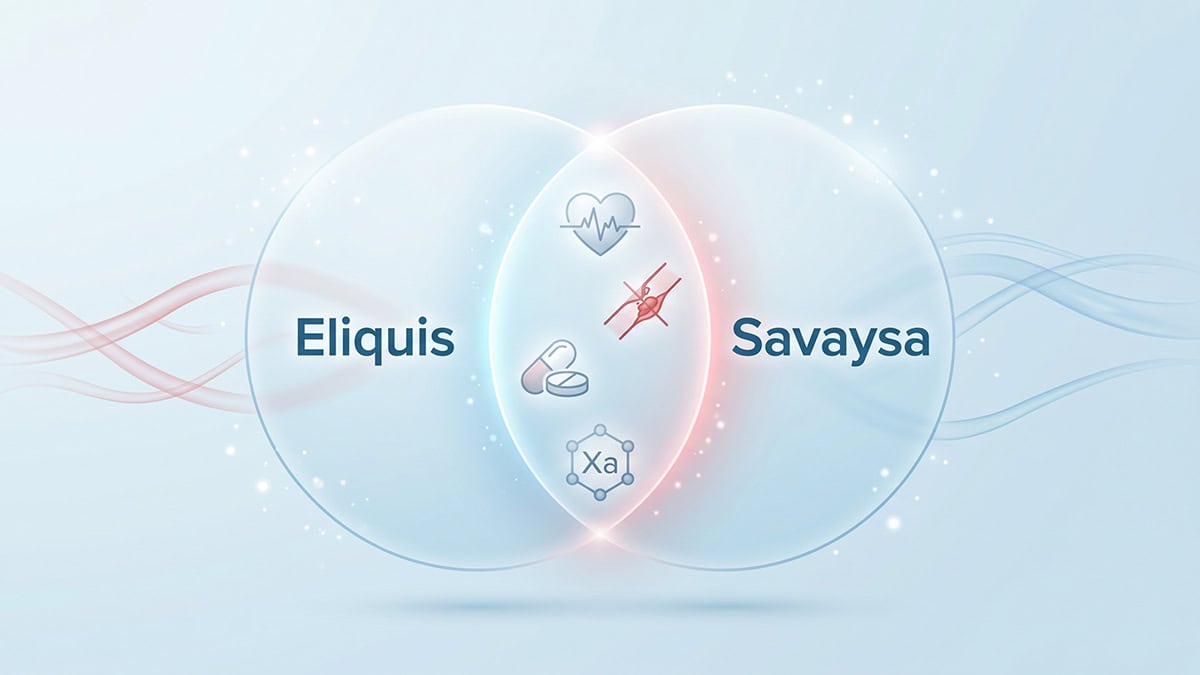
It’s easy to see why people compare Eliquis vs. Savaysa.
Both drugs, after all …
… Are direct oral anticoagulants
… Work by inhibiting Factor Xa
… Are taken orally
… Help prevent dangerous blood clot formation
… Are used in patients with atrial fibrillation and clotting disorders
Both medications are also designed to reduce the risk of serious complications such as:
- Stroke
- Deep vein thrombosis
- Pulmonary embolism
Because their overall treatment goals are similar, many patients wonder whether one is clearly superior.
The reality is just a little more complicated than a quick, binary answer.
Eliquis vs Savaysa: Important Differences
Although both Eliquis and Savaysa belong to the same drug class and have quite a bit in common, they do differ in several practical ways.
For example, their:
Dosing Schedules
Eliquis is usually prescribed twice daily, while Savaysa is generally prescribed once daily.
For some patients, a once-daily schedule may feel simpler and easier to remember.
Others have no difficulty maintaining a twice-daily routine.
Kidney Function
Kidney function can play a very, very important role in anticoagulant selection.
Because these medications are processed differently by each individual patient’s body, each person’s health care provider will start the “which medication” conversation by assessing a person’s:
- Kidney health
- Age
- Weight
- Other medical conditions
… when deciding which option is most appropriate.
A Doctor’s Own Prescribing Experience
Eliquis and Savaysa are newer medications.
Savaysa more so than Eliquis.
In fact, Eliquis has become one of the most widely prescribed anticoagulants in the United States, and many providers have extensive experience using it.
That does not mean Savaysa is ineffective or inappropriate.
It just means that in some cases, it may not be a physician’s go-to – yet. If you suspect that Savaysa is a good fit for you and your health goals, it may be a good idea to ask your doctor about it directly. (But be open to what they and their experience have to say about it!)
Savaysa Side Effects
The most common Savaysa side effects are generally related to its intended effect: reducing blood clotting.
Because the medication makes it harder for blood clots to form, bleeding-related side effects are the primary concern.
Commonly reported side effects may include:
- Bruising more easily
- Nosebleeds
- Gum bleeding
- Prolonged bleeding from cuts
- Minor bleeding episodes
Serious Bleeding Risks and Warning Signs
Most bleeding events associated with Savaysa are pretty minor.
That said, serious bleeding can occur when you’re on an anticoagulation medication – and when you’re bleeding seriously, you’re going to need immediate medical attention.
How do you know the difference?
That can be a judgment call, but, for the most part, if you notice any of the following, it’s likely time to call your doctor or even, in more severe cases, head to the emergency room:
- Unusual or persistent bleeding
- Coughing up blood
- Vomiting blood
- Black or tarry stools
- Blood in the urine
- Severe or unexplained bruising
- Sudden dizziness or fainting
- Severe headaches or neurological symptoms
If any of these things are happening, that doesn’t necessarily mean that you’re having a life-threatening emergency … but you do need to get prompt evaluation to make sure that you’re okay.
Remember: We’re not bringing up these risks to make you scared, or to point out that any of these medications are not appropriate for you.
Instead, this is just information. Information is power! All anticoagulants carry bleeding risks; knowing that ahead of time can help you select the right med for you and prepare to mitigate any side effects you do encounter.
Is There a Generic for Savaysa?
There isn’t an approved a generic for Savaysa, no.
This isn’t necessarily a bad thing.
The reason most people opt for generics is to save money, of course …
… and if you’re purchasing your brand Savaysa through a Canada pharmacy online or international drugs site, you may already be enjoying steep savings along with the convenience of shipping your medication directly to your front door.
If you choose to take Savaysa, your doctor can let you know when you’re able to switch to a generic alternative – but that could take a very long time. The patents for these types of medications often don’t expire for several years.
In the meantime, you can buy brand Savaysa right here for about $9.20 per pill or savings of up to 50% when compared to typical American brick and mortar pharmacy prices.
Is There a Generic for Eliquis?
Has your doctor prescribed you Eliquis, instead?
If so, you can also buy either brand or generic Eliquis right here starting at about $1.60 per pill.
Questions to Ask Your Doctor About Savaysa or Eliquis

Your doctor can help you determine which of these two meds, if either, is best for you.
We understand, though, that you likely only have a few minutes with your physician to have that conversation – and preparing for your doctor’s appointment can be stressful.
- Why are you recommending this medication?
- How does my kidney function affect treatment choices?
- What side effects should I watch for?
- What should I do if I miss a dose?
- Are there medications or supplements I should avoid?
- How long will I need anticoagulant treatment?
- What symptoms require immediate medical attention?
What About Switching Between Blood Thinners?
Sometimes, even after you put all the work in to select the right medication for your needs and goals, later on you do need to consider changing your medication plan.
This can happen for a litany of reasons.
For example:
- The side effects with one medication may prove to be a non-starter.
- Your insurance might change and make selecting one medication over another seem more financially feasible.
- You might receive another diagnosis that could impact your treatment plan.
- Your healthcare provider might have an updated preference for you in terms of prescriptions.
Know this, though: Switching blood thinners is not something patients should attempt on their own.
Doing so effectively (and safely) requires careful timing. Otherwise, you risk excess bleeding, inadequate anticoagulation, or even an increased risk of clotting.
Ready to Purchase Your Savaysa or Eliquis?
Both Savaysa and Eliquis belong to the same modern class of anticoagulants.
And that class of anticoagulants has the same overall goal: Reducing the risk of dangerous blood clots.
Further, both Savaysa and Eliquis …
- Are Factor Xa inhibitors
- Are oral medications
- Help prevent stroke and clot-related complications
- Offer a more predictable anticoagulant effect than older therapies such as warfarin
Picking between the two usually comes down to subjective factors, like your own individual dosing preferences, your doctor’s familiarity with newer drugs, and your medical history.
Once you and your doctor settle on an anticoagulant that offers the best balance of effectiveness, safety, and convenience for your specific needs, you can buy your Savaysa or Eliquis here for about 50% off typical brick and mortar pharmacy prices in the United States.
Got any questions? We’re here to assist.
The entire team here at NorthWestPharmacy.com looks forward to supporting you and your healthcare journey.


